Sunday, August 20, 2006

Of Ants and Aphids

Guarding Aphids

Whenever I stroll through the prairie I have a special interest in checking out the milkweed population. Originally this was due to my ongoing fascination with the monarch butterfly, but over time, my fascination with milkweeds has taken on a life of its own. They typically host a very interesting assortment of colorful characters -- insects of various types sporting bright colors to advertise their toxicity after feeding on milkweed. However, there are also milkweed plants devoid of most of the more usual creatures found on the plant and instead evidencing an active patrol of black ants. Invariably upon closer inspection of these plants, one will find a colony of bright yellow oleander aphids somewhere near the top (more tender) part of the plant, attended by one or more ant guards. It is possible to find colonies of these aphids without the ants, but with a resident ant patrol, their quality of living is greatly enhanced. The aphids have many mortal enemies-- lacewing larvae, ladybug nymphs and adults, and aphid wasps to name a few, and the aphids themselves are defenseless apart from their toxicity from feeding on milkweed which deters some predators, but not, for example, the ones mentioned above. So when they're tended by ants, life is good. The ants post a guard around the aphids and then patrol the plant for invaders, killing them or driving them off. In addition, at least one research study has found that ants will remove diseased aphids from the closely packed "herd" in order to prevent the spread of disease. In return for all this care, the ants enjoy the sweet "honeydew" which the aphids secrete as they process the sap they suck from the plants.

I find such mutually beneficial relationships, of which there are seemingly countless examples to be found in creation, fascinating. Although both the ants and the aphids can and do exist independently of each other as well, there are many cases where its difficult or impossible to imagine the one species surviving without the other (the yucca plant and yucca moth are a classic example). While I know there are explanations put forth for such symbiotic relationships in evolutionary texts, I see such harmonies as yet another testament to the creative and intricate design of a world created by an infinite and all-wise creator.

Saturday, July 29, 2006

Extravagance

Profusion of Flowers

In this picture, taken at a local prairie, there are at least eight different types of flowers all in bloom at the same time (click it to see a larger version -- how many different kinds can you find?). I find this extravagant. And of course the flowers catch our attention, but there are probably dozens of other plant species, several kinds of small animals and thousands of species of insects, spiders and other invertebrates hidden in the few square yards captured in this picture. It seems that when God created, He wasn't content with "just enough" and He didn't stop with "plenty"-- creation is overflowing with the superabundance of His creativity and delight!

I remember a Far Side cartoon entitled something like "God creates the snake" which depicted God rolling out long strands of play-doh as any preschooler would and exclaiming "Oooo. These are easy!" While there's a lot in the cartoon we might take issue with if we took the cartoonist's view seriously, I'm convinced that God thorougly enjoyed the process of creation and delighted in the rich diversity and myraids of variations in the plants and creatures He created. In a 2005 article entitled "Somewhere Out There, Millions of Species Await Discovery," Tina Butler writes that the current number of identified species in all kingdoms comes to about 1.75 million but that 15-20,000 new species of animals alone are discovered every year and that the UN Global Diversity Assessment estimates that there may be as many as 13.6 million species out there! If these estimates are anywhere near accurate, not only do we "not know the half of it," we don't even know a fifth of it!

So why this extravagance? I find it difficult to imagine such extravagance being the product of a grim, harsh survival of the fittest kind of process. I believe it's yet another expression of God's glory in His creation-- a demonstration of His creativity, power and, for lack of a better word, completeness. He doesn't do things partway: "Well, here are three different types of flower for the prairie environment -- that ought to do it!"

And it's a gift. We don't live in a boring world. Imagine having to tell your children, "Sorry, honey, there really isn't anything new left to discover..." We are apparently only scratching the surface (and of course, that's not even counting how much we don't know about the species we do "know"!)

Sunday, April 16, 2006

New Life

dogwoodinSpring.jpg

Today is Easter Sunday, the celebration of the resurrection of Christ. Countless sermons preached today no doubt drew the inevitable parallel between the promise of new life offered by the resurrection and the emergence of new life so abundantly manifest in this season of spring. The co-occurence of the resurrection of Christ with the beginning of spring is, I am confident, more than just a happy coincidence.*

A major reason for this assertion is the fact that the timing of the Jewish Passover celebration, which set the stage for the crucifixion and resurrection of Christ, is tied into the historic events that it commemorates -- the deliverance of the Jewish nation from Egypt under the leadership of Moses (Exodus 12:42). It is abundantly clear from the narrative in Exodus that the this event was entirely dependent upon the intervention of God-- from the preservation and preparation of Moses to lead His people to the ten plagues which led to the end of their bondage. The timing of the Passover events and its subsequent commemoration, therefore, was in the hands of God and He, in His infinite wisdom, saw fit to bring this to pass in the spring.

The Passover celebration was not just the historic context for the arrest, crucifixion and resurrection of Jesus (e.g. Matthew 26:2), but Christians from the time of Christ see in it deep symbolic significance foreshadowing its fulfillment in Christ (I Corinthinans 5:7) and view the timing of Christ's death and resurrection during the Passover celebration as further confirmation of the significance of the relationship between the two events. The sacrifice of a spotless lamb to protect those who partake of it and take refuge under its blood from the judgement of God is a clear picture of the sacrifice of Christ on the cross, the one John the Baptist called "the lamb of God who takes away the sins of the world" (John 1:29).

But I will go one step further. There are those, perhaps, who would explain the celebration of Easter as the result of the hope engendered by spring. However, for me it is quite reasonable to believe rather that from the creation of the earth God intended spring to engender the hope of new life as a witness to the resurrection to come. Peter says that Jesus, the "sinless, spotless Lamb of God," was chosen "for this purpose long before the world began" and speaks in this context of His resurrection from the dead (I Peter 1:18-21, New Living Translation). This was in God's mind when He created the world, so just as God prepared the way for the events of Easter through the events of the Passover, I believe He designed the whole rhythm of summer-fall-winter-spring as a yearly testimony to the possibility and promise of new life in Christ.

*I do realize that for people in the southern hemisphere, resurrection Sunday falls in the fall, and further, that spring does not occur, to speak of, in the tropics. Still, I will argue that for those in the temperate regions, spring is a powerful display of new life intended to point us to the hope of resurrection.

Saturday, December 03, 2005

Metamorphosis


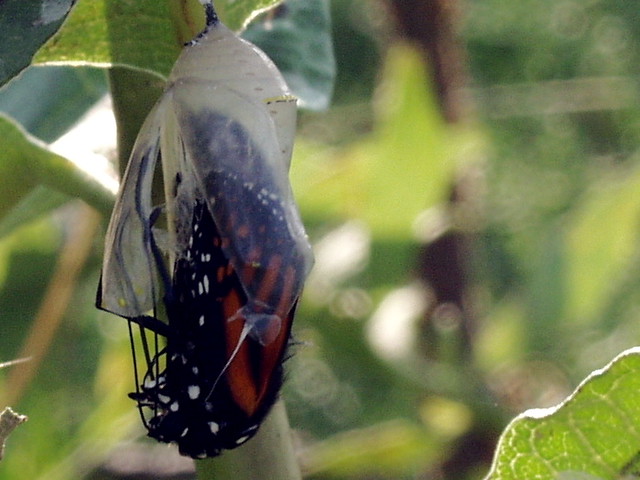
Emergence
It is difficult to imagine in all of creation a phenomenon more dramatic than the process of complete metamorphosis as demonstrated in the life cycles of several orders of insects, but most famously and remarkably in Lepidoptera-- the butterflies and moths. The immensity of the transformation that takes place from caterpillar to butterfly stretches the limits of human comprehension. The physcial changes themselves-- consider the eyes, the mouth, the feet, the antennae for starters, not to mention the whole new dimension of wings -- are mind-boggling. But then take into account the complete reprogramming of the instincts required to make sense of the new body and the process of metamorphosis is orders of magnitude more complex than first imagined.

I have witnessed a monarch's first flight and it was graceful and sure. This was its first experience with wings, yet it soared above the earth as if it had been flying all its life rather than spending its entire existence clasping and crawling. Likewise, from a creature that had devoted all its waking hours to devouring milkweed leaves it had been transformed into a periodic sipper of nectar; from a life spent on its food source to a life of free flight, identifying refueling stops as needed by sight and smell from afar. Flight and feeding are just two of the more obvious abrupt behavioral changes between larva and adult-- there must be countless others as well involved in making sense of such a huge difference in body and lifestyle.

Such transformation as seen in complete metamorphosis is radical and extravagant-- certainly not, at least to my mind, something that would be easily predicted or explained by a theory of existence based on random chance occurrence and competition for survival. Certainly Lepidoptera fill their niche wonderfully, efficiently and quite successfully, being the second largest order of insects in number of species, but how on earth would such a biologically extravagant life cycle come about solely by random chance and incremental change? I'm sure explanations have been advanced and I'll be interested in reading them when the opportunity presents itself.

My contention, of course, is that this extravagant life cycle did not come about by accident but was designed for a purpose. In addition to the elegant manner in which the life cycle of butterflies and moths fits their ecological niches, I firmly believe that metamorphosis was expressly designed as a natural illustration of a powerful spiritual truth. This radical transformation in lifestyle is the perfect illustration of the spiritual transformation that takes place when anyone puts his or her faith in Christ and receives the gift of new life that God offers. As the apostle Paul wrote to the believers in Corinth:

"Therefore, if anyone is in Christ, he is a new creation; the old has gone, the new has come!" (II Corinthians 5:17)

The spiritual transformation described here is taught throughout the New Testament and is every bit as real and radical as the metamorphosis that takes place in Lepidoptera -- in fact the same Greek word is used to describe it in two passages (II Corinthians 3:18, Romans 12:2).

Wednesday, September 28, 2005

Look at the lilies...

Michigan Lily

When I came across this Michigan Lily growing in our local prairie, I could not but concur with Jesus that "Solomon in all his glory was not dressed as beautifully as they are." Jesus uses this observation as part of an object lesson to his followers that they can trust God to meet their basic needs just as He provides for the birds and the flowers. We don't have to worry.

But implicit in this teaching is also Jesus' view of creation-- that God is active, involved and purposeful in the design and care of what He's created right down to the gazillions of flowers and birds that we so easily take for granted. We can see the hand of God not only in the original design of the world around us, but also in its daily provision and care. And following Jesus' lead, we can learn from it because there is meaning and purpose in the design of creation and in God's activities. It is not the meaningless result of random chaos. May we learn to "look at the lilies" and see and understand like Jesus.

"And why worry about your clothes? Look at the lilies and how they grow. They don't work or make their clothing, yet Solomon in all his glory was not dressed as beautifully as they are. And if God cares so wonderfully for flowers that are here today and gone tomorrow, won't he more surely care for you? You have so little faith!"

Mathew 6:28-30

Wednesday, August 24, 2005

Prayer of my Heart

Sequoyas

Lord, let me be a tree
Standing strong and steady
Roots holding fast and reaching deep
Into the depths of your truth.

Lord, let me be a tree
Strong and sheltering
Branches stretching upward, leaves ever turning
Toward the warmth of your love.


But his delight is in the law of the LORD,
and on his law he meditates day and night.
He is like a tree planted by streams of water,
which yields its fruit in season
and whose leaf does not wither.

                                                       Psalm 1

photo for this entry by Jason Mills

Monday, August 01, 2005

Intricacy

July Prairie

Ahh Lord God, in the orchestration of life You have shown such care, such fine-tuning, such brilliance! The intricate interdependence between so many plant and insect species is such a common example that we easily take it for granted. A walk on the prairie between late spring and the first frosts of fall reveals a constant hum of activity centered around the flowers currently in bloom. The profusion of plants and pollinators on the prairie is an amazing thing, but even more wondrous is the fact that not all pollinating insects visit all flowers indiscriminately -- flower design (coloration, shape, fragrance, season of blooming, time of opening, length of time available, etc.) often favors specific pollnating species. The striking red flowers of the royal catchfly, for example, favor pollination by certain butterflies since bees do not "see red". And yet it all works in concert such that species that rely on nectar and pollen have a sufficient food supply when it's needed, and all flowering plants have an adequate number of appropriately equipped pollinators at the season they're in bloom. There is a complexity and beauty here that defies any attempts to unravel it all, but You Lord God have it all in hand. It is a startling symphony of life and you, Lord, are the composer. Thank you.

Wednesday, July 06, 2005

Brevity

Ohio Spiderwort

The beauty of a flower quickly passing serves as a reminder that our time is short on earth. This theme is threaded through the Bible from Job to James, and though the applications vary (Job laments the hardships of our brief life, David comforts the righteous that the wicked will quickly pass, James warns the rich that their lives will soon be gone...), the underlying theme is clear: our time is brief-- is there a hope for eternity?

Isaiah plants a seed of hope:

"Shout that people are like the grass that dies away. Their beauty fades as quickly as the beauty of flowers in a field. The grass withers, and the flowers fade beneath the breath of the LORD. And so it is with people. The grass withers, and the flowers fade, but the word of our God stands forever." (Isaiah 40:6b-8)

Peter, who quotes the Isaiah passage, brings the seed to fruition:

"For you have been born again. Your new life did not come from your earthly parents because the life they gave you will end in death. But this new life will last forever because it comes from the eternal, living word of God." (I Peter 1:23)

There is a hope for something more. As the dying flower produces the seeds of new life, so there is hope for us as well, but our hope does not spring from within-- as Isaiah intimates and Peter proclaims, it comes from the living word of God. God has not left us without hope! I leave the word to speak for itself (the link is to I Peter 1 for starters -- for further reading suggestions, feel free to email me at dmills727@gmail.com.

Wednesday, June 22, 2005

Immensity

Grand Canyon

"When I look at the night sky and see the work of your fingers--
the moon and the stars you have set in place--
what are mortals that you should think of us,
mere humans that you should care for us?"
Psalm 8:3-4

There are vistas, Lord, I'm sure You planned specifically to remind us how small we really are. Standing on the beach surveying the vastness of the ocean; overlooking the splendor of the Grand Canyon; lost in the depths of a star-studded sky. These experiences are meant to silence our busy self-importance, to humble us before You as we are reminded of Your immensity and our own helpless insignificance.

And yet our smallness finds immense signficance in You. As David expressed it as he continued his contemplation of the night sky:

"For you made us only a little lower than God,
and you crowned us with glory and honor.
You put us in charge of everything you made..."
Psalm 8:5-6a

Lord, lead us in wonder, humility and awe to a fuller worship of You and, in turn, to the fullness of our destiny in You. Amen.

Tuesday, June 14, 2005

What Makes for Success?

Snapper

The photo is of a baby common snapping turtle I crossed paths with one fall day in southern Illinois. A couple of days ago I was watching part of a children's Saturday morning nature show with my kids as a well-known host wrestled a huge alligator snapping turtle (a different species than the one pictured here) onto shore and proceeded to discuss its early evolutionary success due, in part at least, to the fleshy appendage on its tongue which it used as a lure to catch unsuspecting fish.

Now this is a children's show and so one does not expect a PhD dissertation on how the fleshy appendage might have evolved, and I do not fault the show for not going into more detail on that. What strikes me, however, as something I'd want to know more about is how an evolutionist explains the behavioural dimension to this development. It does not seem that far-fetched to think that a fleshy appendange might genetically show up on the tongue of a snapping turtle. BUT as I understand it, in order for that to be a favorable mutation likely to be passed on to succeeding generations, it has to be useful. However, the fleshy appendage itself is not useful until somewhere along the line the turtle with this appendage discovers that it can be used to attract fish. How does this happen? And assuming that it happens, how does this newly discovered knowledge get passed along to any of the offspring fortunate enough to inherit the fleshy appendage, so that the appendage helps provide a competitive edge to that generation as well and so assure its spread through the race? They are not likely to learn the behaviour by watching an adult since turtles in general do not care for their offspring but lay the eggs and leave them to hatch and fend for themselves (like the little guy in the picture headed for the water).

As I have opportunity to learn more about the evolutionary perspective I will keep an interested eye open for explanations of how necessary behavioural modifications are explained. Not suprisingly, however, I find it much more reasonable to believe that the fleshy appendage on the tongue of the alligator snapping turtle is not the product of random chance but is there by design, and that the One who designed it also packaged the necessary behaviours to use it successfully as instinct to be passed unfailingly from generation to generation.